
As a what?
Grace Notes #13: On being an end of life doula

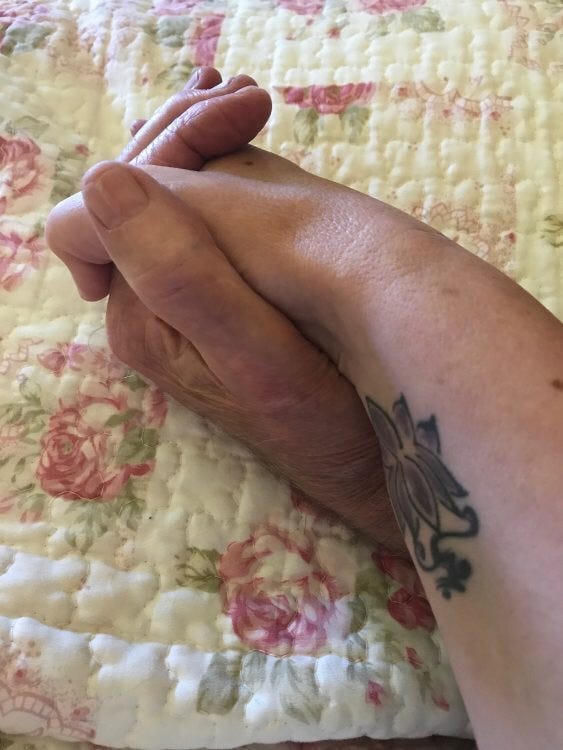
When I tell people I have trained as an end of life doula, the most common response is “as a what??”
While end of life or death doulas are a little more common in North America (one appeared in a recent episode of The Pitt), here in Scotland, as in the wider UK, we are an emerging profession.
Many people associate the word doula with birth, with midwifery, with someone who holds a labouring woman’s hand. In fact the word comes from the ancient Greek doulē, which loosely translates as a woman who serves.
But end of life and doula in the same sentence? That’s new for many of us, and it touches something most of us would rather not look at: the simple fact that one day we, and everyone we love, will die.
So today I want to tell you what an end of life doula actually is. What we do. And why I think the best time to engage one is long before you think you need one.
The short version is this: an end of life doula offers emotional, practical, and spiritual support to people who have a life-limiting illness, and to those around them. We are not medical professionals. What we bring is something the medical system cannot give enough of: time. Time to be with you, and to hold space for the tender conversations about what, and who, really matters, in the end.
In practice, this work can take many forms.
It can be companionship in the last months and weeks of life. Taking a dying woman to do her Christmas shopping, because even though she would not say it, she knew this was her last Christmas. Sitting with a gentleman half-way through his memoir, listening and asking questions and typing, so that his remarkable life story will not be lost.
It can be being a quiet presence in the room when the family needs to step away, or when the person who is dying simply wants to talk to someone who will not be devastated by what they say.
It can be practical help: thinking through how someone would like their ending to be, and making sure their wishes are documented and properly registered. It can be creating legacy projects, or choosing the music and poetry for a celebration of life. It can be as simple as making tea, walking the dog, helping to organise belongings.
It can be supporting a family who want to care for their person at home, right to the end. Helping them create a calm, comfortable space to die in, and holding them steady through it, because they still have to eat, to sleep, to receive those who come to say goodbye, and to grieve, often all at once.
It can be being present at the moment of death, and in the time immediately after. It can be supporting a family to wash their loved one, as a final act of love.
And it can be the days and weeks afterward, when the funeral is over, when it seems everyone has moved on and the silence feels impossible to bear alone. When all you want is to hear someone say your loved one’s name.
What an end of life doula does is simple, and profound. We do not try to fix what cannot be fixed. We do not offer platitudes, or promises that any of it will be easy. We are simply willing to be with you, knowing that this is the "one wild and precious life," lived right to the very last moment. We listen to all of it. And when there is nothing left to say, or when the words feel too painful to utter, we stay with you in the silence.
Years ago, long before I knew that this was the work I would do, I wrote a piece about what I might offer to someone in unbearable pain. I looked into my heart for the wisest words I could find. All I found was: I am here.
That is, in the end, what a doula offers. Not answers. Not fixes. Just steady, attentive, unhurried company at the edge of what cannot be made otherwise.
Most of this work begins not at the edge, but with a single, unhurried conversation, long before anything is urgent.
If you have ever wondered what that conversation might be like, I offer a free one to anyone who wants to take a first step.
We might talk about the things most of us never quite get around to saying out loud. Who would you want with you? Where would you want to be? What do you want to happen at your funeral, the music, the words, who reads them? Have you written any of it down, and does anyone else know?
Or we might simply begin to think about what a good ending could look like for you, and how to start those tender conversations that feel so hard to begin.
There is no obligation. Most people come away saying they wish they had done it years ago.
Take your time. There is no rush. But the wise time, the time you will never regret having spent, is now.
much love
Susan 🌹
How utterly sacred and beautiful!